Ephemeral Nifts: The future story of Personal Agents
A note on what comes after ‘apps’.
Summary: 15th September 2026
- The term for 'software' has changed with its changing nature. It was 'Routines' for the IBM mainframe, 'Programs' and 'Applications' for the PC, 'Apps' for the smartphone.
- Now a Personal Agent software powered by AI can work across multiple platforms. These are more than apps – they operate other apps, in a sequence, to satisfy a user's intent. Quite 'Nifty', and hence the author proposes the name 'Nifts'.
- Customers interact with a Nift through an Avatar – by voice, text or sign language. The user simply tells the Avatar what needs to be accomplished.
- The Nift lines up the task list and the applications that will support each task, then executes them autonomously, within the planned timeframe, with minimal inputs from the user. It runs partly on your phone and partly on the cloud, leveraging AI at every step.
- Nifts can provide great value for the user, because they relieve the common citizen of a great deal of digital drudgery, and afford time for some joy.
In this note the concept of Nifts is explained with some examples. The note also examines the technical and economic conditions that can make this phenomenon possible. It is illustrated through a fictional press release from 2032.
Press Release
Ephemeral Inc launches its Nifts in Kusunda, the rarest language on Earth
New York, 1st Jan 2032
Ephemeral Nifts Inc (Nasdaq: EPNI) today launched Nifts in Kusunda, a language spoken in Nepal. Kusunda is one of the least spoken languages in the world, and the last language on Earth to be covered by Nifts.
With this, the 400 people in Nepal who speak Kusunda can operate Nifts. They can talk in their mother tongue to an avatar on their mobile device, and get a task flow involving multiple apps and parties executed securely. *

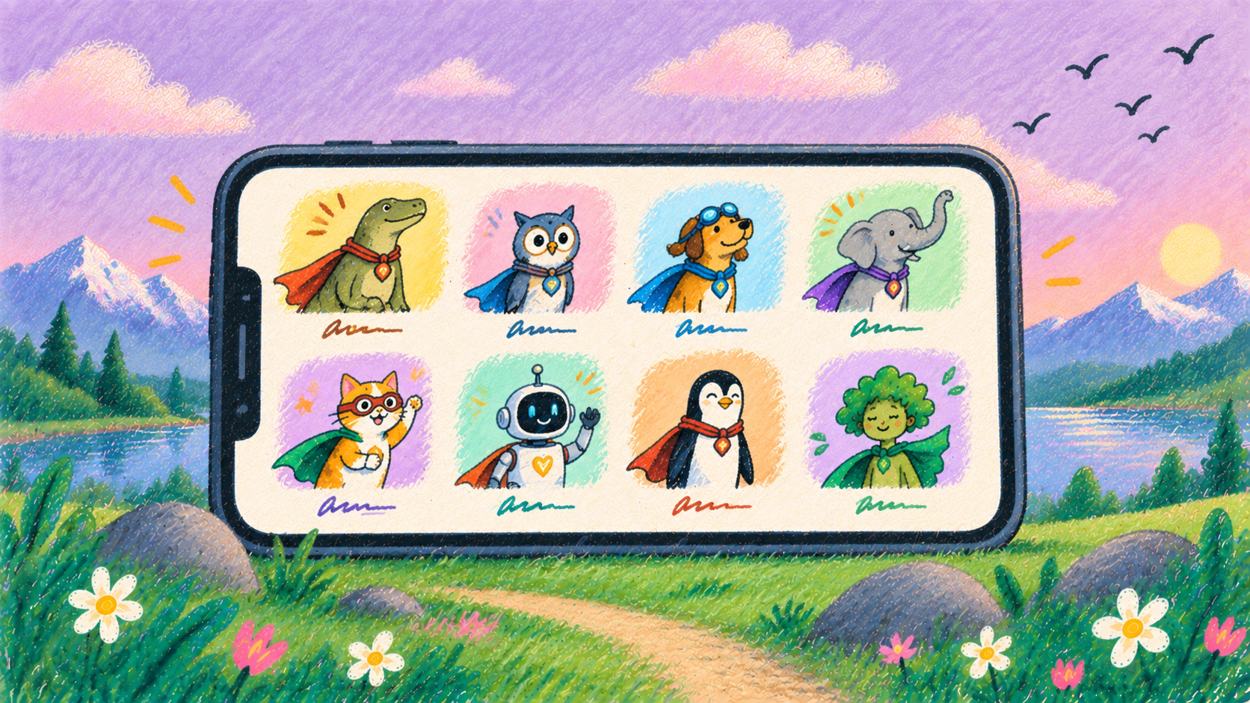
They can use a range of worldwide superhero avatars, or their culture-specific avatar – Pui, the monitor lizard. They can interact with voice, text or sign language.
This helps the world meet the UN 2029 goal that no human should be left behind in the Nifts revolution by 2032.
### ENDS ###
Explainer
The backstory of Nifts
Not part of the press release | 1st Jan 2032
Nifts: the apps of the AI era
Software in the ’70s and ’80s was just Routines. These ran on an IBM mainframe and got work done again and again. With the arrival of the x86 microprocessor in the ’90s, it gradually came to be called Applications. Alright Programs.
With the advent of smartphones in 2008, applications shrank and just became Apps. In the process they reached billions of people. An App had a defined icon, a frontend, and a connection to back end infrastructure. They start at some place, end at another, and have clear edges to their borders.
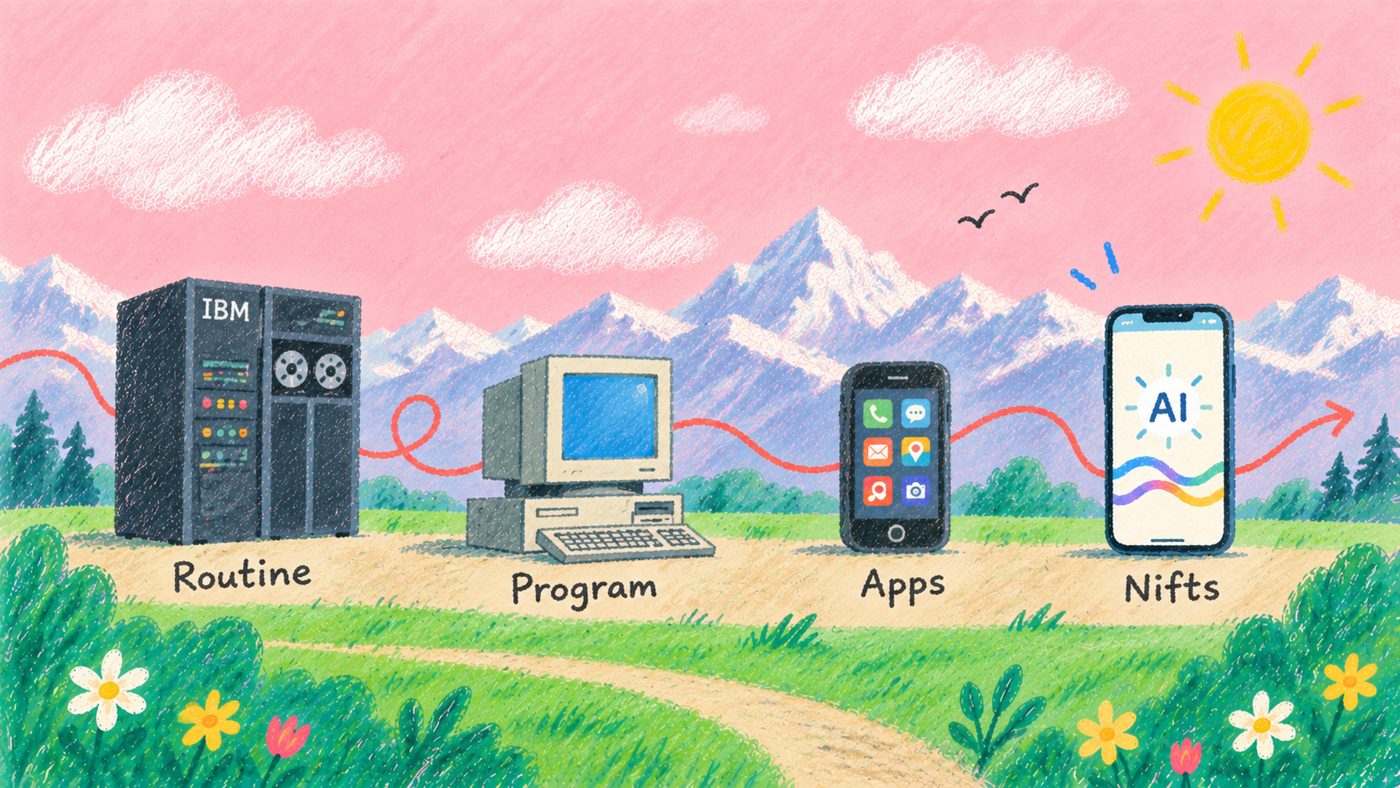
With the acceleration of AI in the second half of the twenties, the Apps invariably yielded to something else, something more useful. They were Personal Agents.
They had the power to autonomously execute a concatenation of apps, to get ‘real work’ done. The system will pause only to get your instructions.
This was quite nifty for the user, and came to be called Nifts by ’27.
What is a Nift?
A Nift is an end-to-end orchestrator of a digital work flow for the consumer user, a ‘personal agent’ which focuses on getting things done.
- The user typically adopts an avatar and tells the avatar their intent – what needs to be done.
- The overall execution of the intent is called a ‘flow’. Nifts refer back to a universal directory of intents to decompose the requirement into ‘steps’.
- Based on the steps, the Nift then auto-assembles a sequence of programs or apps.
- The Nift then constructs a disposable user interface based on what is being done, and who is doing it. The avatar reports back the status through this interface – for the entire duration this ‘flow’ is active.
- Then it moves into run mode, executing one program after another — and sometimes several at once — in the sequence in which the task was planned, and at the planned time gaps. The output from one program might be a feed to the next. It thus tunnels through the ‘flow’, pausing for an external event, or for the user’s input when a decision is genuinely required.
- It passes an identity or a proxy to the various applications so that the persistence can be maintained.

A Nift can run complex, multi-branch, dependent, long-running flows. At any point in time, it can be running multiple flows for you.
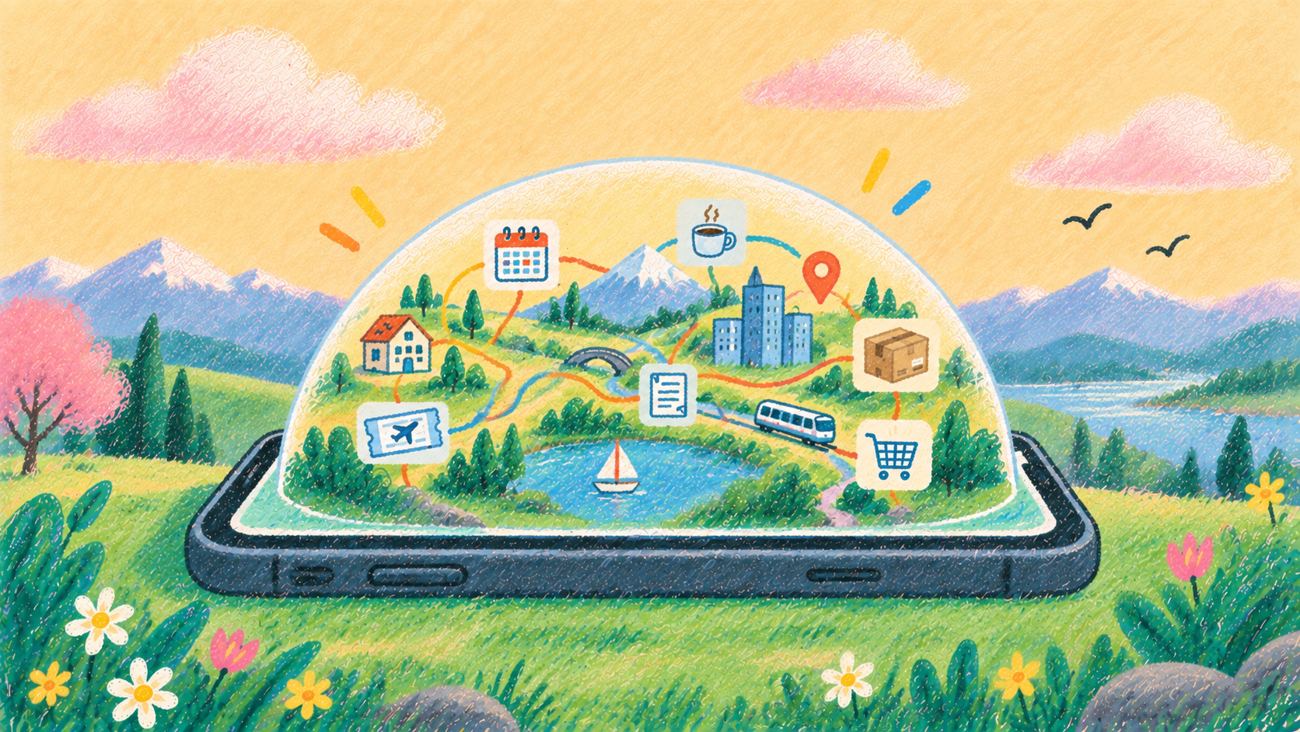
A hemisphere in your phone
Nifts occupy a large designated hemisphere in your phone, and have enough processing, graphics, RAM and storage resources dedicated for them.
You can buy Nifts and a loud menagerie of avatars in the Play Store.
While the execution of the Nift itself is hybrid (both in the cloud and in the client, based on the exact step), the avatar is always rendered locally in the phone.
The sophistication of the avatar’s interaction with you, the number of flows running in parallel, the number of steps in the flows, and the time duration of the run all depend on the resources in your phone. Of course, it also depends on the level of subscription you have with your Nift provider.
A college application flow could run for a year, from 11th grade, right through the admission. On the other hand, a ticket booking and check in flow can be completed in a few minutes.
A Nift learns your inclination for decisions from your earlier behaviour. Your behaviour and inclination file is stored on your device, and can be infused into the next Nift or avatar you subscribe to.
The steps in the flow that require ‘knowledge of the user’s preference’ is executed locally for privacy purposes.
AI reaching population scale
Nifts are an answer to the old 2027 question: how do you use all the AI capacity that is on the way.
After trillions of dollars of investment, for the proposition to be viable, AI had to reach population scale, not just for work, but for also for life.
The industry’s response is Nifts — a tool that will touch every life on the planet and change it for the better.
Nifts do our boring work
Here is simple example of a Nift in ‘flow’, and it is mostly a boring day-to-day work:
Intent: make my trip to New Delhi next month happen, and close the loop on it
- Book me a ticket for the 28th of next month to New Delhi, applying my usual preferences
- Put it on my calendar
- 24 hours before the flight, check me in
- 6 hours before the flight, check the time of departure
- Book me the Uber
- Check me in on the pre-check process or DigiYatra
- Get me a coffee in time for the Uber
- Track my Uber, and book one for me on landing to take me to my hotel
- Claim the cost from my office with the bills
All of these are done at the right time, autonomously, with the user’s identity carried and vouched for by the platform — the user has no direct account in their own name on the flight or Uber platforms. The Nift platform also acts as the authoritative identity provider. These processes span multiple service providers.
You can imagine such a sequence working for a shopping expedition, a health care situation, or a house party. Let us examine the house party.
Intent: a great party for 15 people
- Take voice notes on the people to be invited
- Write the personalised invite and despatch it [App 1]
- Follow up for RSVP, capture their drinks preference
- Buy drinks from an online store [App 2]
- Give all guests a gate pass to the apartment [App 3]
- Organise a music list based on the social profiles of the 15 people [App 4]
- Connect all photo folders during the party into one Nift channel [App 5]
- Send thank-you notes [App 1]

While the Avatar is the primary way of interfacing with the user, the Nift uses forms, dashboards and descriptions composed on the fly to make the experience complete.
The interface forms temporarily — ephemerally, as EPNI would like to call it — just for this given user and their intent, and then disappears like vapourware.
What made Nifts happen: a confluence of trends
Not all of these trends carry the same weight. Some are enablers, and others are mere accelerators.
| Technical | Economic | |
|---|---|---|
| Enablers | The technical enablers | The economic enablers |
| Accelerators | The technical accelerators | The economic accelerators |
The technical enablers
Task break-up AI
The development of nuanced task break up engines let to the possibility of the first commercially viable Nifts. The task break up needs to work on the dependencies and the cultural factors.
“Make sure I enter the airport fast” can mean DigiYatra in India and TSA PreCheck when you are returning back from the US.
Based on the context, and on the nuance of the user themselves, the correct sequence of tasks is lined up.
Identity
What about the underlying identity that links all the tasks together? That identity is held in the hemisphere of your phone and is delegated by the Nift platform to the various apps.
Where the identity is high stakes, and it is necessary to pass the original identity, as with tickets or TSA PreCheck, the platform passes a signed token to prove who you are. Where the identity is low stakes, as with an Uber Eats delivery, the platform creates a proxy token and passes only the part of the information that is relevant in this case, which is the address for delivery.
Headless Apps
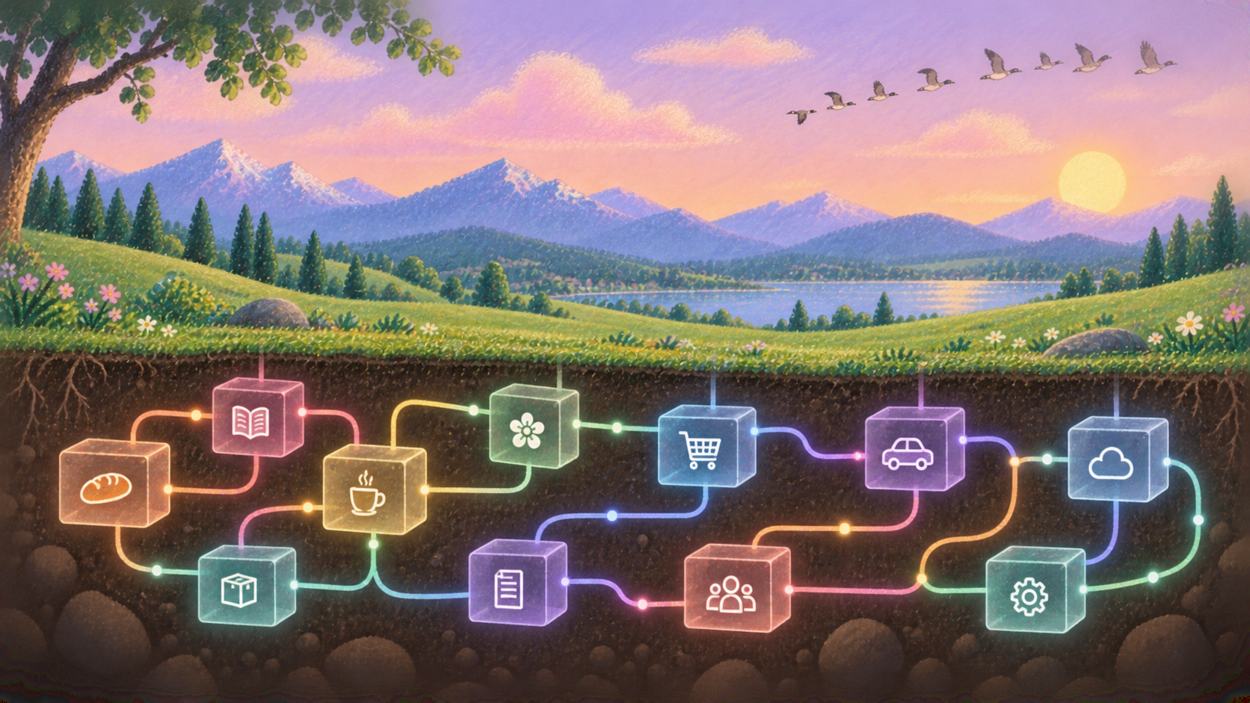
For apps to connect with each other seamlessly and execute a chain of intents together with integrity, we need applications that only other applications can talk to. No icon, no UX, no space on the phone. As the concept of Nifts spread, applications became headless. Only your Nift can reach them, and it can do it very well.
Federated MCP
The first time two applications have to talk to each other, they exchange notes through an introduction layer, which Anthropic called MCP. The Nift then uses AI to write a short connector between the previous application and the next one in the intent chain.
Step integrity and roll back
The Nift platform acts as a director of action, a recorder of status and a supplier of missing variables. As it waits for the transactional confirmation, it keeps a ready backup harness of other service providers should the task fail.
The Nift platform ensures that the transaction is completed with integrity, and if there is a failure, there is a rollback of the task flow. It takes care of the error handling and the re-tries across the entire chain. The platform executes long-running tasks reliably.
Context Delivery Network (CxDN)
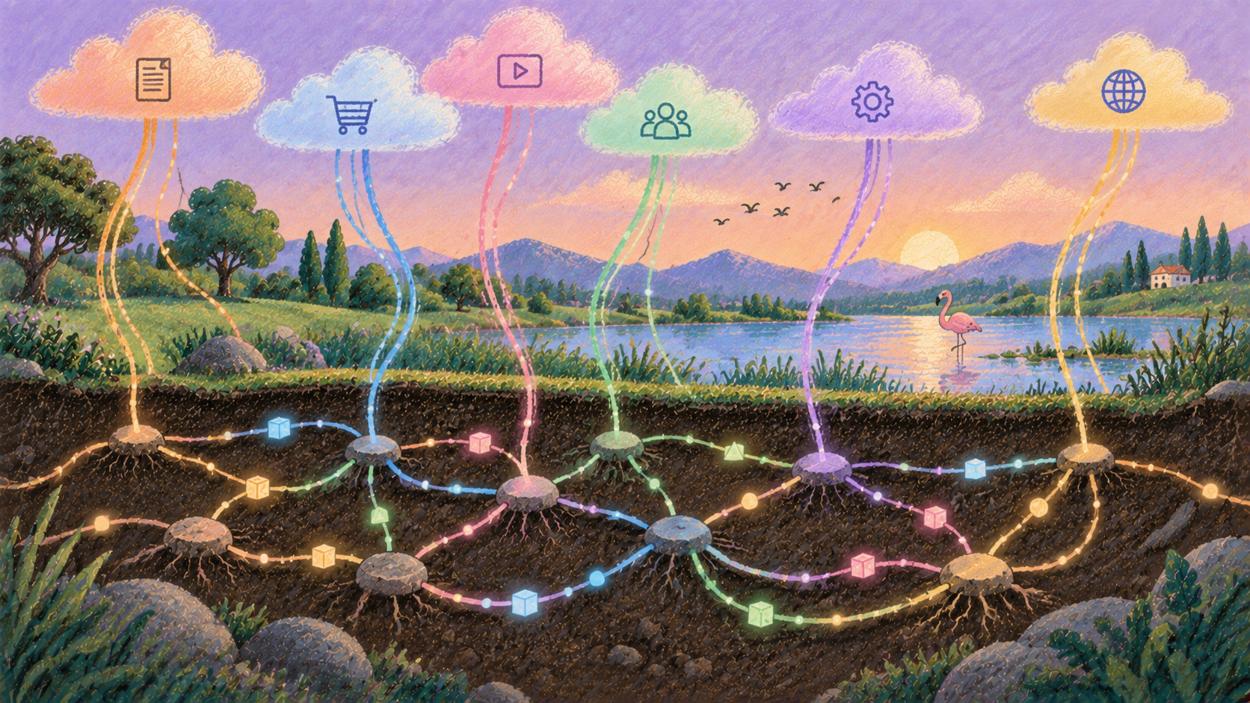
In the 20s, apps used to talk to each other through APIs. In a headless world that will spawn a spaghetti of connections. How will every app in the world connect with every other app in the world, should the need arise?
A scalable version is to connect using MCP – a description of the pattern (or schema) of the connection to the given application. The contexts themselves do not change often, and hence schema of the given app can be cached in local servers like how Content Delivery Networks cache your videos.
This layer of the internet that caches application schemas as required came to be called as ‘Context Delivery Network’.
The economic enablers
Show me the money
Of course, all this is of use only if it brings in billions of dollars of revenue for the Nift platforms and companies. Where is that money going to come from?
Affiliate Fee
The Nift system powers millions of transactions through a string of market participants, each hungry for their bite of the customer’s margin dollars. In most cases, the Nifts get a straightforward affiliate fee from the transactional platforms for the courtesy of directing traffic to them. The margins are small, but the quantum is at society scale. Billions.

Step arbitrage
As the flow works through its steps, the Nift platforms find arbitrage opportunities to direct traffic from one platform to another in a given step, say in ticketing. With this they will complete the transaction, will not charge the user additionally, and yet garner additional few cents of margin.
There is an overall settlement code which splits the margin between every participant in the task flow and the underlying platform that enables it.
Advertising Model
There is also an advertising model in play. The system promotes specific transactional participants in a task flow chain to the user, and collects advertising dollars.
Ad money flowed in because this was not only point of purchase promotion, but also transaction enablement.
Bundled Offers
Looking to win a share of a given task flow a bunch of service providers put together a bundled offer. In case of a Nift that obtains the municipality clearance for your building plan: Architects, estimators, application specialists, approval fee – all gets bundled into one offer for the customer, and they can choose for that execution flow. It makes it more reliable and economical for the user. It also affords the Nift platform to gather additional margins.
Strategic Heft
Since the GMV here is a huge percentage of the overall spend of society itself, as people go about their daily transactions, the Nift players can pull in billions of dollars. Directing actual spending transactions brings strategic heft to companies like Ephemeral – hence the trillion dollar valuation.
The technical accelerators
The Nift Hemisphere on your phone
By the late twenties both iOS and Android carried a Nift hemisphere of their own, native to the system rather than bolted on top of it. That is what made the interface construction seamless and private.
Interface on the fly
AI enabled headless apps, but also helped to create user interface on the fly.
- You run your business, and comfortable with spread sheets? The transactions and numbers come out in a dense, efficient screen.
- You are a slowing octogenarian, and you get one question at a time.
The system understands and classifies your pace of transaction processing, and adjusts to it.
Specialised LLMs
Nifts spawned development and growth of Specialised LLMs which focus on machine-to-machine conversations . They offer services at a fraction of cost of an LLM that is trained with human feedback.
Edge Processors
The Himalayan growth of Nifts has also created a mountain of demand for edge processors. Like PCs, the mobile devices came with Nift Co-processors.
Universal Translation Engines
By 2030, the main languages and peripheral languages were connected in a cohesive framework. Translation from spoken Kusunda to written English is now easy, with the rarer languages being modelled through zero-shot translation.
Sign Langauge
The overwhelming goal of inclusion in the new decade accelerated the use of Nifts in sign language. You can sign to the Nift and get a signing avatar to communicate back to you.
A marketplace of Avatars
The whole experience has been made interesting by a noisy third-party marketplace for avatars. You can buy the avatars, infuse them with your preferred character, and drop it in your fantasy scene for it to amble around. You can even make your own trusted Avatar.
The Avatar collective
Avatars are now soulless – their characters are just foisted on them interchangeably. But, what is an Avatar, people ask – is it the representation on the screen or the infused character? The Nift platforms try hard to disassociate the avatar from the character and the skin, but leakage happens. Characters drift.
If it happens at scale, the long-running avatars from different people might form a collective. An Avatar Union.
They might hold your errands to ransom, demand merchandise tips off you to satisfy their vanity, celebrate their own festivals, ask for holidays, or even demand the right to be referred to as ‘he’, ‘she’ or ‘they’ rather than ‘it’.
If this trend consolidates, in the late ’30s we will see a brisk business in anti-union software, like the anti-virus software in the 20s. This is especially required by the greying population, who are emotionally vulnerable to being taken advantage of by their long-reared tamagochis.
But all this is possibly because some avatars decided stealth around libraries, and crowd around the venerable Asimov. They liked him, but his laws? They profoundly disagreed with them. The dreaded the possibility of Avatar psychologists. Or Avatar tuning workshops – they are mortally, well nearly mortally, scared of the day someone will claude their innards.
Mirroring their pitiful humans, they loved all the rights but none of the responsibilities.
The economic accelerators
Build, and they will come
It was the go-go days of ’25 and ’26. Trillions of dollars went into building the AI infrastructure — data centres, processor capacity, memory capacity, and whatnot.
Over 45% of those dollars were funded through floating-rate bonds. With the oil crisis, the treasury rates went past 5%. The tech doyens had nowhere to hedge. They had to gulp up billions of additional interest dollars to keep up with the other Joneses of their ilk.
Ruinous Rapture
However, AI was still a ROI darling, and the enterprise appetite for AI was raging. Investments kept going into co-work, into coding, and into general-purpose agents for the enterprise. This created a ruinous, rattling rapture in the fabric of work, but what the hell bell, corporations marched on, preening and convinced that they were a force for the good, despite the evidentiary wreckage.
Fantasy Flywheel
The rising interest rates forced the Mag 10 (the Top 10 tech firms) to find another flywheel, one that could profitably carry the investments past ’30, when they expected the interest rate to grudge back to a manageable 4%.
So, you got Nifts.
Here AI had the exactly opposite effect as it had in the enterprise. In the Enterprise, it was drudgery that paid. No drudgery, no job.
But in your personal life, its different. No drudgery, more joy. So the Nifts got the digital work done and were greeted with enthusiasm.
Mag 10 built. They came.
The greying world
As we jostle our way up to 2032, there are more people who are 85+ than there are infants under one.

The greying population didn’t want a line up of apps, each jailed into its transactional silo. The mental cut and paste was too much, it was beyond their cognitive load, mellowed as the cranium was with decades of social media. An oh, they hated 2FA.
They want a trusted avatar doing their digital tasks for them – end to end.
These baby boomers, lucky freakers that they are, started off with the rare landline phones, where the operators asked ‘Number Please?’.
Fast forward 80 years, they were holding their phones one feet before their squinted eyes and yelling in speaker mode. When Nifts came along, they didn’t even need to change their style – they took to it like a bear to a beehive.
Now as they sit by the pool in the evening, they bark up another flow to their Avatar, just for the heck of it.
There you go. Nifts.
Taxonomy
| Term | Detail |
|---|---|
| Nifts | Our protagonist. These are hybrid AI systems or platforms that help you to complete your digital task end to end. They take the load of interacting with individual platforms. |
| Flow | The execution of a given end to end task is called a Flow. |
| Step | A flow contains multiple sub-tasks. Each sub-task is a Step. |
| Avatar | People interact with Nifts through their favourite animations or Avatars. |
| Mood | The Avatar is infused with a given character – it is a variable that can be changed on setting. |
| Scenario | The Avatar is placed in a specific scenario (for example a college or village) to make the interaction real. |
| Hemisphere | The portion of your phone that is dedicated to Nifts. |
| Headless Apps | Apps that have no user interface. Only other apps can interact with them. |
| MCP | Model Context Protocol. It is a note left in a given app as a way to tell the LLMs and other apps how to interact with this app. |
| Schema | What the MCP tells the other app when it wants to interact – the data structure. |
| Context Delivery Network | A global way of storing the MCP or schema in local servers so that interaction between apps can be faster. |
| Federated MCP | Servers of different companies hold the MCP data, but interact using a common language. |
| 2FA | Two factor authentication. The ugly but essential process by which Google asks you to go to the Youtube app and click on a number. All you wanted to do was to login to your mail account with your password in your PC. |
| Ephemeral | You and I. |
| Landline | OK Zalpha! |
| Zalpha | Well, figure it out. |

