
Once in a millennia something comes along that changes the game for every human being. Not a new app. Not the smart phone. Not steam engine. Not even electricity. Something fundamental, derived as a culmination of the previous millennia of developments.
Managed fire was one. Books were another. I think AI is the third.
AI has the ability to raise all boats — even if some elite parts of society are inconvenienced, discomfited, and ultimately disadvantaged. This has happened before – with the introduction of ‘managed fire’ and books. And in every case, the democratisation of any ‘fundamental technology’ provides advantages to the have-nots more than the haves.
India, at a per capita level, is a nation of have-nots. We should embrace AI in education, healthcare and skills.
Fire: Life
For most of human history, you didn’t make fire. You found it. Lightning would strike a tree, and someone would carry the embers back to a cave. Lose that fire, and you’re back to darkness, cold and raw meat. The fire-keeper was the most important person in the group.
Then, about 400,000 years ago (as they found out in 2025) humans figured out how to make fire on demand. Flint struck against iron pyrite. Sparks. Flame. The fire-keeper’s monopoly was broken.

This was fundamentally a health revolution. Cooked food releases far more calories than raw meat. The human brain consumes a disproportionate share of the body’s energy. Some say, cooking fuelled brain growth over hundreds of thousands of years.
Managed fire didn’t just improve life. It made the modern human mind possible.
A man was found thawed out of the Alps after thousands of years — Ötzi the Iceman — and he had a complete fire kit on him. By the 1700s, the tinderbox was the smartphone of the era. Everyone had one, carried it everywhere and used it daily. Just like mobile phones.
Then friction matches came along. But it was flintstones and the tinder box that started the phenomena of ‘managed fire’.
Was fire dangerous? The elite didn’t want fire to be widely available – they cited safety reasons and ‘entrusting the poor with such big responsibility’. Every culture has a ‘fire stealing’ mythological story.
The fears were not entirely wrong. Fire burnt cities down, was used in wars. But fire made life better for everyone, including the ones who lost power as a result of it.
Books: Knowledge
Before books, knowledge lived in memory and oral tradition. Then came scrolls, written by scribes — expensively, exclusively. The vast majority of people couldn’t read or write. Knowledge was not just expensive. It was inaccessible.
Around 1440, Gutenberg, perfected the printing press with movable metal type. His Bible came out about 15 years later. A couple of hundred copies.
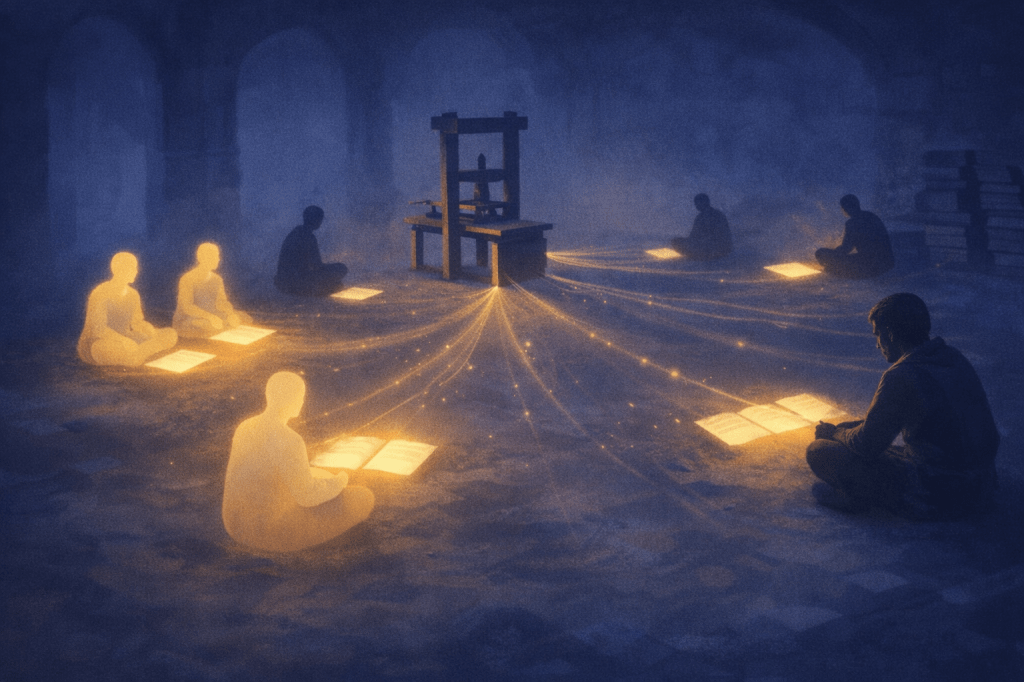
What followed was, by medieval standards, viral. Within a generation, presses had spread to every major European city — Rome, Venice, Paris, London. Within 50 years, hundreds of presses across Europe had produced millions of books. The cost of a book collapsed from a house to a month’s salary. Every town could suddenly have a library.
The elite struck back. A clergy called the printing press a whore and the pen a virgin. Said it spread knowledge to people who ‘weren’t ready’.
India achieved 80% literacy just in 2025. Yes that’s right, only that %% of people can learn from books.
This knowledge gap with the western world will be consequential for decades in terms of the society development.
Were there costs? Yes. Scribes lost their livelihoods. Calligraphers went from being elite to exotic. Religious wars were fuelled by competing texts.
But the book technology didn’t corrupt the people. It educated them. The second order effects were valuable to Europe – the books in fact started the scientific revolution, and has lead into the world as we know it today. The change made life better for everyone.
AI: Intelligence
The dominant conversation about AI is about who loses. Software engineers. Consultants. Knowledge workers.
This misses the point entirely. The real story is not that AI replaces engineers. It is that AI enables accountants to write software. Doctors can build diagnostic tools. Teachers can create curricula. Farmers can build predictive models. Everyone punches above their station.
The bottleneck shifts from ‘can you code?’ to ‘do you understand the problem?’ — and the aptitude for the second question is distributed far more fairly across people in a society.
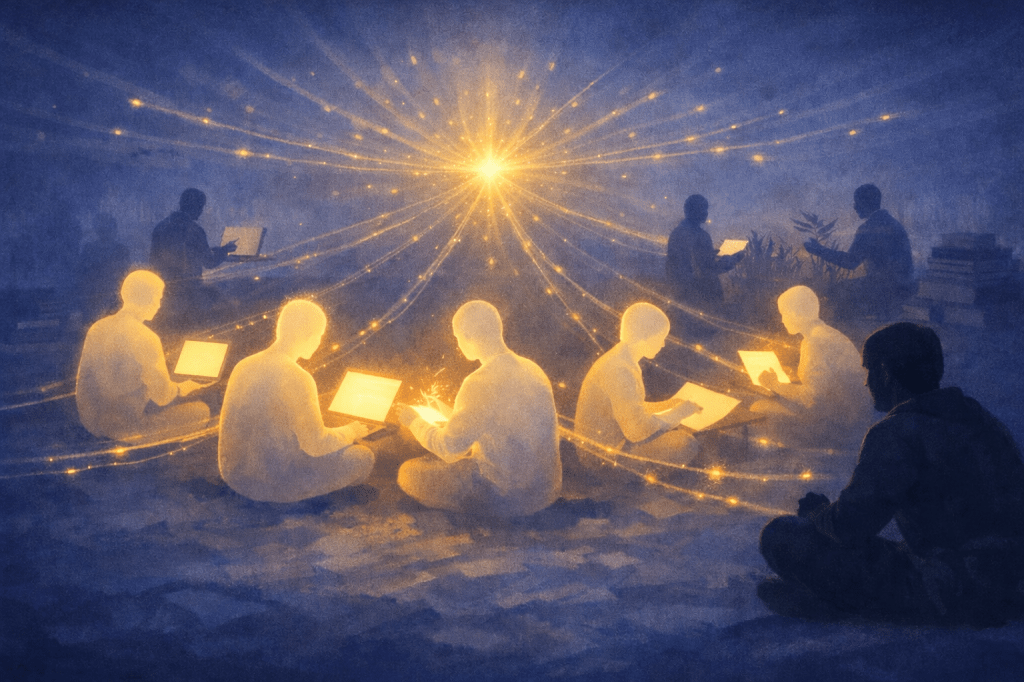
The elite whose way of life is disrupted are more immediately but not more profoundly impacted than the scribes of Venice or the fire-keepers of prehistory. Those people lost everything. Today’s professionals have transferable skills and economic cushions that medieval scribes did not.
In any democratisation, the have-nots benefit more than the haves. India is, at a per capita level, a nation of have-nots — in education, healthcare, access to professional skills.
At India, we have a few million software developers but tens of millions of small enterprises. Not enough doctors. Hundreds of millions of students, chronic teacher shortage. Where we are, with AI, we have more to gain than to lose.
Incredible second order effects of AI
Mobile phones connected hundreds of millions who never had landlines. The second order effect is more valuable. Aadhaar and UPI became possible — the greatest exercise in democratisation of identity and money. Economic growth followed. But in my personal view, the impact of mobile phones on society, while significant, was not as far reaching as fire or books.
AI, I believe, has the ability to transform more than mobile phones did — like fire and books before that. Properly harnessed AI will spawn off an dizzying projectile of second, third order effects that can transform the nation.
This liberalisation will cause overall growth. Maybe we can even create the conditions for Nobel laureates.
How AI is different
There are significant differences between AI and the other two.
In AI there is concentration of the force. That’s new. Gutenberg’s press was quickly copied by hundreds of independent printers across Europe. Today’s AI models are controlled by a handful of companies, the entry barriers are high. Unlike a printing press, you cannot set up another simple AI model in Faridabad.
The speed is also new. ‘Managed fire’ probably took centuries to spread across the ancient world. The printing press took half a century to spread across Europe. AI reached hundreds of millions of users in months.
Thanks to the speed, both the second order effects – displacement and benefits – will be faster. The forces that will gain the most can the struggling silent majority – who can harness AI for education, healthcare and skills.
The forces that will be disadvantaged are the current ‘elite’ in the society. They will silently oppose AI through regulation and bureaucracy.
We have higher literacy and digital connectivity, and live in a connected world. So, benefits will flow in faster, but the displacement will also be faster.
Flintstones, Books and AI
AI is not normal technology. (Yeah, I am referring to this paper).
It is more than a better dating app. More than the mobile phone. Or the 3nm chip that powers it. Or the Internet. Or even PC that started the revolution. Or the processor before that. Or the electricity that made this possible. Or the steam engine.
It is a culmination of all these, distilling the benefits of all these to the man in the village, in form of ‘intelligence’. It is a once-in-a-millennium opportunity — like flintstones and books.
It is a culmination of all these, distilling the benefits of all these to the man in the village, in form of ‘intelligence’. It is a once-in-a-millennium opportunity — like flintstones and books.

There are differences between this revolution and those that came before. There will always be differences. But in every case, the pattern holds. Democratisation disrupts the elite, unsettles society, and raises everyone.
India should embrace AI. Love it. Learn it. Make it an immutable part of our society, much like fire, books.
 Future starts mid-week
Beautifully written- this really resonated. I especially appreciate how you frame AI as something that raises all boats, expanding opportunity rather than concentrating it.
The emphasis on democratizing intelligence .enabling more people to access knowledge, creativity, and capability- sounds both hopeful and grounded. It’s a powerful reminder that technology, at its best, amplifies human potential.
Articulated very thoughtfully!