
Man’s population downfall started the day the machines came in.
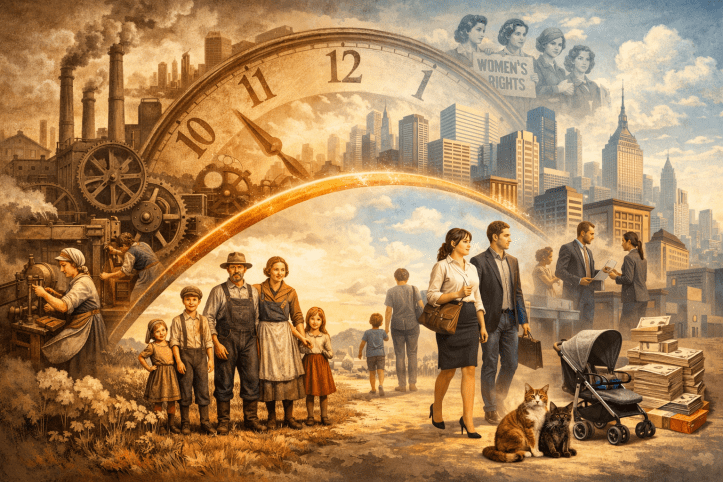
‘Man’s population downfall started the day the machines came in’, said I to my friend.
My friend said, ‘I don’t see it that way. The world population grew the fastest in the 20th century (1.6bn to 7bn) – so much so it was called population explosion which makes it a very abnormal century’.
This is how I justified my statement. These are my arguments.
A century to pass on the message
In the overall sweep of time, the aforesaid century is a blip. Man’s population decline began with machines, though it took a century to see the effects. The absolute increase in population explosion happened in places where machine productivity didn’t reach.
Society usually saw additional hands (and hence children) as incremental productivity pools. They had the benefit of ‘green revolution’ to take care of the food. The moment a machine is introduced, productivity is disconnected from number of hands. Then the incentive to have additional children is reduced. This message takes time to be realized by family units.
This paper discusses this phenomena in detail.
Marginal cost of every additional child
It was economically advantageous to set up the first factories in ‘cities’ where access to man, machines and material was easier. So, jobs concentrate in urban clusters. As the urban cluster builds, the cost of living goes up as a large pool of people (per sq km) are competing for the same services (Schools, Hospitals, Piano teachers and what have you). This drove the costs higher. The marginal cost of ‘maintaining’ each additional child was higher compared to the earlier agrarian environment.
This necessitates increased income. Jobs are abundant in a ‘factory’ oriented urban cluster and the factory owners have incentives to keep additional ‘supply’ to keep their labor cost low. Over time, the use of machine required repetition, finesse and discipline than sheer physical strength. Women joined the job pool. This ‘first wave’ moved the role of women from the ‘family productivity pool’ to ‘factory productivity pool’.
Change in family capital structure
This required different ‘family capital infrastructure’ like Fridges, Ovens, Washing Machines and may be Juicers and Air-friers. This requires more factories. That required more labor. This became a self-perpetuating cycle.
This phenomena increases the disposable income per family unit. This also decreases the percentage of income spent on food and sustenance.
This increases the service economy. More labor required – more piano teachers. More women enter workforce – this was the ‘second wave’, where some of the women moved from factory labor to the service economy.
The service economy increased, enterprises needed more ‘office workers’. This was more productive per capita than factory work. Employers demanded education. Now 3-4 generations of working women have whizzed past, and the family units realised that the key to incremental productivity of any person is education. Perhaps even attend college.
Parents of girls also realized it. Girls got into education and college. At this point, the women’s transformation from ‘family productivity providers’ to ‘economy productivity providers’ was still marginal.
However, they are active participants in the economy. Their vantage is now different from the women just 3 generations back, who were solely ‘household benefits’ providers. They gained additional freedom, independence and power.
Third wave of enlightenment
By this time, the woman are enlightened to the value of equality. They talk about rights. They burn bras. They go to college with a vengeance. They adopt contraceptives. They develop alternative arguments for abortion.
Both well-intentioned and economically incentivised forces talk about glass ceiling. About DEI. This was the ‘third development’ – after the first 2 economically induced ‘waves’, this was a culturally induced one.
Along the way, the women also realised that having children was a ‘economic productivity disincentive’. Pregnancy, childbirth and traditional roles had a negative impact on their career and earnings.
No spare for the heir
Machines gave wealth. Wealth led to sanitation. Wealth also resulted in better health care. In the 100 years of this progress, the infant mortality rate also came down. [1/6 over 125 years]. Even if there is a need for an heir, the biological need for a ‘spare’ came down.
Since the opportunities were in the cities, the ‘traditional large family unit’ broke down and yielded into ‘nuclear families’. The influence of the previous generation waned, as was their ability to keep this nuclear unit in the ‘traditional mould’.
The costs for the ‘family unit’ to maintain the children were increasing further as the urban cluster builds out further. But they have to remain in the ‘urban cluster’ as that is the source of well paying jobs, education and healthcare services.
Dwindling filial ROI: Less financial, more genetic and emotional
The economics and the capital structure of the ‘family unit’ changed with increase in real estate and healthcare costs.
The ‘family heads’ had to ‘invest’ in the child. Upon graduation (end of the ‘investment period’), the offspring started a separate nuclear family unit, so there was very little financial ROI to the original family. And again, there were no marauders to fight off in the night – so the security ROI was also not there.
The return of investment of a child was more genetic and emotional. So, over time, for many in the society, the marginal cost of the child became more than the marginal benefits of not having one.
Sometimes even no heir
Smaller urban spaces allowed for pets rather than children. For emotional ROI people also relied on pets. This might explain the growth of pet owning homes from the ‘80s to ‘25.
Economic and social changes created the space for ‘culture’ and ‘way of life’ to override ‘darwinian’ gene pool drives. Some now prefer cultural legacies over biological lineage. This phenomena is still rolling out as we speak.
So, in the 125 years of sweep and furtherance of the society, the total fertility rate has gone down.
It all started off with a machine.
 Future starts mid-week