
Strategic questions other players will have to confront
In this blog, let us look at a few strategic questions the key players in the value chain will have to confront.
Given a possible disruption of Intel’s competitive advantage, what are their opportunities? What are the threats that they might face?
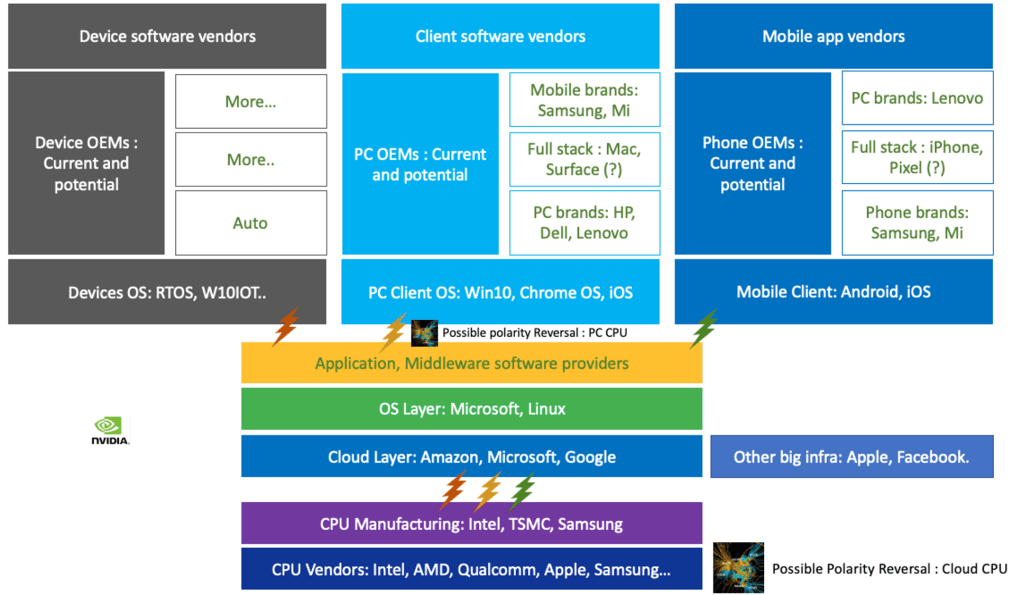
The stack of players impacted due to Intel x86 related disruptions
CPU Vendor Layer
AMD: The Master Survivor:
- Will the continue their performance parity with Intel due to continuous, relentless improvement in their x86 PC and Server processors?
- Will they be able to align manufacturing capacity with TSMC and Global Foundries in light of the capacity pressures?
- Will they be able to use their ‘We try harder’ DNA to win in the ARM PC/Server processor space? Will their Xilinx acquisition help them to ‘breadth new life into the data centre’ business?
Qualcomm: The future brain?
- Will Qualcomm along with Google’s Android be able to redefine what a ‘Personal Computer’ is and have its own high-performance computers that can run Android apps?
- Will their Chinese JV partner bring out a viable ‘Data Centre’ chip to the world, given Qualcomm itself has exited the space? Will that be acceptable for ‘Data Centres’ worldwide from a security standpoint?
Apple: Is it the post-PC world yet?
- Will Apple be able to bring in 10+% performance increase year after year for the next few years?
- How much influence will Apple have on TSMC’s strategy and alignment?
- Will Apple be able to thwart Nvidia’s takeover of ARM?
<Here Apple is the CPU vendor. Of course, it vends to itself>
CPU Manufacturer Layer
TSMC: The foundry:
- Will TSMC establish fabs across geographics (US, Europe) to balance geo-risks associated with Taiwan?
- Can TSMC retain its pre-eminence in semiconductor manufacturing for the next decade?
- Will TSMC licence its fab designs and processes to scale?
- If and when the demand sags (in the cyclical business), will TSMC be able to manage the downside?
Cloud Vendor Layer
AWS: Long term player:
- Amazon develops its own ARM processors for the AWS data centre. Will they continue to get price-performance advantage with their Graviton chips. Will they be able to drive a double-digit mix of ARM Graviton processors in the data centres?
- Will they have significant cost advantage over time in this game? Amazon, as we know invests for the very long term.
- Will the transition to their own chips for their Echo, Tablet, Kindle and Fire TV Stick devices?
- Will Amazon | AWS provide ARM PCs to develop and test application software for ARM servers?
- Will AWS be able to thwart Nvidia’s takeover of ARM?
AWS’s own chips is a pricing and strategic threat for Microsoft Azure. The situation is akin to Google’s OS only play (Pixel is small) in smartphones vs. iOS’s full stack play.
Microsoft Cloud: Two markets at stake – Windows and Azure
- So, will Microsoft be forced to build their own client processors? [There is news]
- Will they buy out a company like Ampere – which is specialized in designing ARM processors for the data centre?
- Will they produce software to help developers deploy easily in ARM based servers?
- Given that Google Android/Qualcomm/Google Suite are tightly integrated, will that combination attack Windows/Intel/Office 365 combination? Will Google Suite gain advantage over Office 365 in this scuffle?
- Will Microsoft be able to thwart Nvidia’s takeover of ARM?
Google Cloud: New to the party:
- If AWS and Microsoft have their own processors for the server stack, can Google be far behind? Will they not seek their own processors stack across Pixel and Cloud? Which one will they prioritize first? I feel it will be the server processor, given they have a smaller stake with the Pixel.
- Given the disruptions in the Microsoft stack (core Intel is getting replaced by ARM – Google has a deeper legacy with Android in ARM), can they aim at attacking Office 365’s dominance with Google Suite?
- Will Google be able to thwart Nvidia’s takeover of ARM?
Cloud OS Layer
Linux:
- Will Ubuntu and other distributions maintain roadmap parity between their ARM and x86 distributions?
- Will they provide tools (on the cloud may be) to test applications on ARM/Linux distributions easily?
- Can application providers test in their legacy x86/Linux based PCs and deploy it ARM/Linux systems?
Microsoft
- Will Microsoft software stack (Windows Server, Exchange etc.) be available in ARM variants? Will they maintain roadmap parity?
- Can application providers test in their legacy x86/Linux based PCs and deploy it ARM/Windows Server systems?
Application Software Layer
- Will it become easy for developers to develop and test applications across the stacks – x86-Windows Server, x86-Linux, ARM-Windows Server, ARM-Linux?
- Will they move to ARM completely or maintain both the distributions, at increased cost of development, testing and security?
- Will they maintain the distributions for Intel once their cloud solutions are moved to ARM completely?
Client OS Layer
Windows
- Will Microsoft Windows 10 offer a ‘Rosetta Stone’ equivalent to run x86 applications on ARM processors?
Android | Chrome OS
- Will Android | Chrome OS with ARM (Qualcomm specifically) break-through in terms of performance and leverage the familiar Android interface?
- Will Android | Chrome OS | ARM become India’s computer stack? Will JioBook shake up the world of computing?
PC Brands Layer
HP, Dell, Lenovo: Need for higher control | Attacked by adjacents:
- Given Apple has the full stack with M1, they have both BOM and integration advantage. That will impact the PC Brands where it hurts the most – the highest end of their laptop stack. How will HP, Dell, Lenovo address Mac’s M1 performance? Will they turn a blind eye, and look at Apple as another island?
- When will they introduce ARM based, fanless laptops? It is just a matter of when.
- Today, the PC design cycle is synchronized with Intel’s roadmap transition. Which beat will they march to, if they introduce ARM based processors? Will they reduce the number of Intel lines due to design costs involved for both the platforms?
- Today, Intel heavily invests in marketing alongside the PC Brands. Will the PC Brands look at Intel as a pure supplier, without the brand ‘aura’ and structure their go-to-market finances?
- The Qualcomm-Android PC will break their industry structure. How well will that be accepted by customers? If the acceptance is high, Smartphone vendors will get into the computing space. They have a greater design innovation legacy, deeper distribution and different margin expectations (especially the Chinese vendors). How will the existing PC brands face this onslaught?
- Will they get into the ‘Surface Hub’ collaborative space? Will they get in with Windows or with Android TV OS? Will they face competition from TV vendors in that space?
Microsoft Surface:
- Microsoft claims they do not complete with their customers – but that is precisely what they do with Surface. Will the PC OEMs look at Surface as competition?
- Will Microsoft bring in fanless designs on Surface, upending the product vs. their Intel offering?
- Will Microsoft refresh Win RT to a more viable offering with a translation layer for Intel software? Will the processor they use (their own or Qualcomm) offer enough performance advantage to take care of the lag introduced by the translation layer. [Microsoft’s equivalent of Rosetta Stone]
M1 Macs:
This was the primary reason that this article was written. The entire article assumes that Apple would have worked a viable, long term, performance gaining roadmap for the M series processors, which I believe they have.
Amazon:
Will Amazon launch Alexa powered touch enabled TVs that will enable collaboration and upend the concept of computing?
Smartphone Players Layer
Samsung
- Is the Surface Hub the future of a new market – where computing, television and touch applications collide? Will it be dominated by Android TV OS? Samsung is best place to dominate this market.
- Will they get into the adjacent laptop space with Android/ARM offerings? Will they have a BOM advantage over other players including Mi as they have backward integration to ARM processors?
Mi
- Similar comments as Samsung except the BOM advantage for the processor.
- Mi can potentially operate a lower margin structure. Also, their GTM is primarily online – so their GTM costs might be lesser than Samsung.
In the middle of the storm: Nvidia
As the new bidder for ARM, here is the player who can potentially have the maximum influence over this eco-system.
When Oracle bought Sun (and hence Java), there was great concern in the eco-system. But Mr. Ellison acted like a gentleman, continued to keep Java open source – pulled in Intel, Apple rand others to contribute to the Java eco-system.
But, will Nvidia have such altruistic intent? Given they are planning to pay a pretty penny $40B for ARM, they have to monetise it. Will that process create a big disruption?
- $40B was about 14X of Nvidia’s Net Income in 2020 and 12% of Nvidia’s market cap on date of announcement.
- When Oracle bought Sun (Sept 2009), it paid $5.6B. That was about 0.9X their Net Income in 2009 and about 4% of their market cap on the date of announcement.
So, Nvidia is not likely to follow the altruistic path. If Nvidia’s bid for ARM goes through, ARM might go the WhatsApp way – there could be some compromise to its soul. For the billions of chips shipped with its core, ARM revenue is estimated to be about $2B in 2020 with an anaemic +5% yoy. Nvidia will want to drive incremental revenue out of the same volume base and then more.
It is like WhatsApp’s founders selling its ‘privacy oriented’ soul to the devil and then crying hoarse. From the moment they put the $32B in (at 43% premium), Softbank were looking for a multiplier exit.
ARM had to unlock some value for Softbank to exit. ARM’s gentle English sail boat business model was under risk.
Faustian embraces are bone crushing.
Given that ARM’s books aren’t in the pink of health (~2B in 2020, with a loss of $400M), why would Nvidia pay such a large amount? It cannot be for the smartphone business, the TAM of which has been flat since 2017.
It has to be to go after:
1. Data Center business (synergistic with Mellanox’s products. Mellanox is another acquisition of Nvidia – they make Networking products aimed at the data centre)
2. Personal Computing business: How will they structure the business? A direct PC business will make the compete with their own customers (like Qualcomm as an ARM licensee and HP as a graphics card customer).
3. New IOT businesses, especially in the Auto-industry.
The 3 top questions for Nvidia are:
Will they be able to pull the ARM acquisition off, despite opposition by Intel, Microsoft, Google, Apple and Amazon?
If they manage to acquire, how will they change the soul of the licensing agreement with the other players in the eco-system? Will they have the negotiating power and legal shoulder space to do so? They will have to ‘unlock the value’ of the existing stack – it is bound to cause disruptions. Can they withstand the disruptions? Do the buyers have an option?
Will they give an advantage to their own products (PC Chips, Server chips etc.)? Will they disadvantage their customers (like Qualcomm)?
If the acquisition bid fails, the top question to ARM is:
- What business model change are they going to do to build on the revenues from $2B? Here is the curious case of a very powerful moat that is not translating into revenues and margins.
- Can an industry consortium fund the purchase of ARM from Softbank (probably at a reduced value) to run it like a standards body? If that happens, will they remain competitive in their roadmap? Will they cede space to x86?
- ARM sold off its China rights to a JV partner. In event of a geographic disruption, will those products come back to compete with ARM in some geographies?
Who ever ARM’s master is – Softbank, Nvidia or a new one – ARM’s place as a disruptor in chief of the computing eco-system is secure for the next few years to come.
What will it take to unseat ARM? We will speculate on it wildly in the next section.
Next: Written on Rosetta Stone #14: From a snowflake to an avalanche
 Future starts mid-week