
ARM twisting into adjacencies
ARM started moving into adjacencies and increased its penetration into the eco-system. This include:
- A design for 3G, 4G modems (Cordex R)
- Another design for really thin phones and CPU packed in a tight space Cordex M)
- Products aimed at the IOT market like autonomous vehicles (Cordex R)
- A version of the processor aimed to work in smart cards (SecurCode)
Frenemies for some time: The ARM Intel symbiosis
The Great Empire of China was just next to the Genghis Khan’s Mongol empire. But for long, the Mongols had the focus on Middle-East. So, China was growing , supplying goods to the resource poor Mongols. The peace and prosperity lasted for a few generations – until Kublai Khan.

Trading partner turns conqueror: Kublai Khan wins over Beijing. Courtesy: Wikipedia
Kublai Khan turned on to China as a target and wrecked havoc. He attacked and disrupted the Silk Route cutting China a key source of power. In fact, it was Kublai Khan who made Beijing as the capital of China.
Like the initial synergistic growth of China based on Mongol riches from the Middle East, Intel grew on top of ARM’s growth.
Smart phone growth created need for apps. Apps had to be hosted on server infrastructure. And Intel was the foremost supplier of the server infrastructure. So, smartphone’s success and ARM’s growth contributed to phenomenal growth of Intel’s server business.
Intel’s server CPU revenues were $5.3B in 2009, and it grew to #23B in 2018. A CAGR of 17.7%. That is fantastic when the business has a >65% gross margin.
We all know only too well. History repeats itself. Intel disrupted the server fiefdom of IBM. Now, what?
Siri, show me the QWERTY Keyboard
An industry standard cannot be disrupted by a better version of the same standard. Disruption will come from an unlikely source and often will not look like the original standard it is replacing.
The QWERTY keyboard was established in 1870 and withstood many attempts to its replacement. The technology that likely replaces the keyboard is dictation to SIRI – something that doesn’t look like the keyboard at all.

ARM starts straying into areas owned by Intel
The ARM designs were becoming more and more sophisticated over years. ARM’s business model was nothing like Intel’s.

Intel plays an end-to-end role in the semiconductor eco-system. It is the be all and end all of its fortunes.
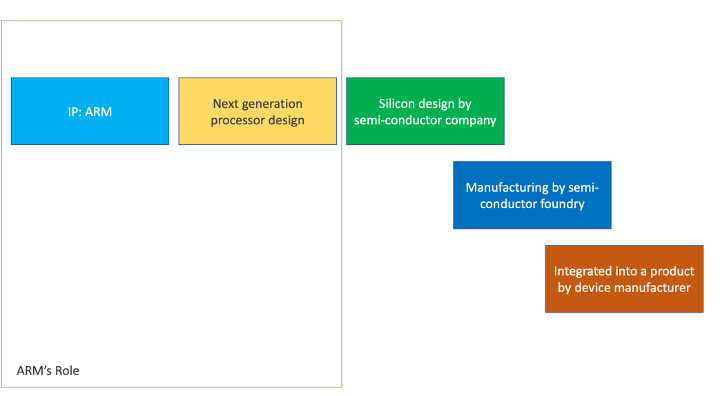
ARM plays a focused, smaller yet core role in the semiconductor eco-system. Many other players in the eco-system are participants of ARM’s product roadmaps and fortunes.
By the middle of the second decade of this century, Intel’s greatest strengths became its greatest hinderances.
New type of server work loads
New specialized server work loads like Machine Learning didn’t require a conventional processor. They were looking at multiple cores at the lowest possible power consumption.
ARM introduced products to address these opportunities:
- In 2014, ARM introduced a Tensor Processing Unit (TPU) focused on Machine Learning type tasks. (Ethanos and co-processor)
- In 2018, ARM introduced processors to address the data centre requirements.
New suitors to ARM
Let us consider GameStop. Obscurity to Celebrity status for GameStop stock was just 1 tweet away: An ‘out of the blue’ tweet by Elon Musk. All types of new suitors (on Robinhood) started buying into GameStop.
Similarly, ARM had to do just this one action to get a set of new suitors: To announce that it is getting into the high margin server chip business. Very powerful suitors lined up to make their Mobile, PC (or equivalent) and server processors.

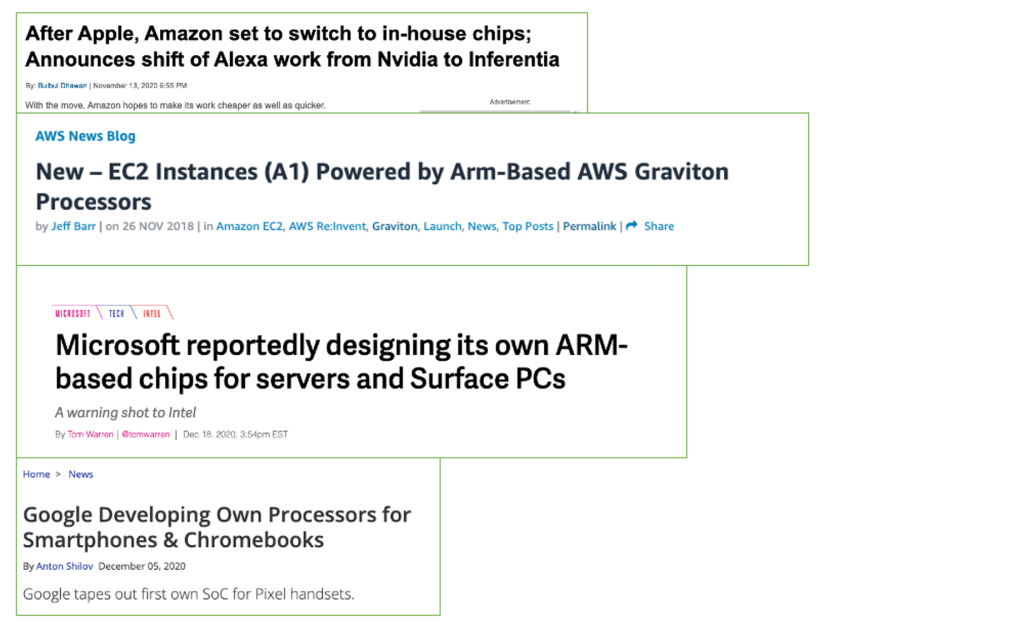
ARM is just the dreamer. Designer. Who is going to convert the wonderful designs from ARM (and the OEM) into actual processors? In comes TSMC, the foundry.
 Future starts mid-week