
Apple’s M1 Processor: The Desolation of the Smaug
“Most companies with a practiced discipline of listening to their best customers and identifying new products that promise greater profitability and growth are rarely able to build a case for investing in disruptive technologies until it is too late”
Prof. Clayton Christensen, in the Innovator’s Dilemma

It was probably around 2006. That’s probably when Intel said no to Apple’s request for a low cost, low power CPU for a yet to be designed device (now known as the iPhone).
Intel just won Apple’s PC business. It was worth billions. Apple is a difficult customer.
No volumes there, the thought probably went. The revenues cannot make a large dent to Intel’s roaring PC driven topline. No margins. It will cannibalize existing business.
What happens to the INTC stock when gross margin % goes down, the team would have argued? Besides, how will Dell react? HP, the largest customer, will whip up a volcano.
The Intel Core 2 Duo processor line that was just launched was breaking new performance barriers at lower power consumption. “The Empire Strikes Back” screamed Anandtech after reviewing the (then) screaming performance of Intel Core 2 Extreme. Centrino, Intel’s laptop offering was doing great.
Intel was focused on winning back the market share from AMD. Focusing on the low power chips is a diversion. Focus.
For a finance and engineering-oriented business team driven by numbers, there was no business case for launching a new low power series of processors. Let us pass this, Intel must have thought. Like the unprofitable government tenders.
They probably told Apple, check it out folks, we do not want to respond to your ‘Request for proposal’ for this mysterious device of yours. No bandwidth. We will let it pass. The Apple folks might have been pretty disappointed to be rejected by the all-powerful chipzilla.
Their work was now harder. Their parental instincts kicked in – after all, weren’t they closely associated with this company called Advanced RISC Machines in the previous decade? Weren’t they on the original CAP table with 43% shares? Let’s see if we get a perpetual licence from ARM (as it is called now), Apple said.
The folks at Intel probably presented to the board how they made the right decision.
No one realized that time that the moment before the Apple folks left the meeting was last moment x86 had a chance to retain its dominance.
Troika for forces
This action from Intel energised a troika of forces that threatens the root of Intel’s dominance in the 2020 decade.
- ARM’s improved its architecture
- TSMC’s had volumes to continuously improve its process capability
- Apple’s built the chip design capability the hard way – powered by ARM’s designs and TSMC’s process improvement.
I should be covering Samsung, Qualcomm and to an extent Nvidia in the same spirit as they were also co-travellers in the journey. But, I am not covering them for want of focus and brevity.

A failure of our imagination: Pre-M1
Even in the fantastic era of possibilities, in the computing world some hard constraints existed. They were conveniently attributed to Moore’s law or processor limits or the R&D investments required. Some specifications were impossible.
A fan less computer? Impossible, except Chromebooks on low performance Atom or Snapdragons.
A fan less computer with faster core performance than anything Intel had to offer? Utterly impossible, they said.
A fan less computer, with fastest performance, greatest graphics, and longest battery life? Huh, said the boffin, it is utterly, nutterly, impossible.
The processor performance boffin
Clarke’s second law
The Apple M1 processor introduced in 2020 hit Clarke’s Second Law out of the park.
Decades of evolution and years of effort have gone into the M1 Mac, but the result is astounding. They wandered well past the realms of impossibility, into a space that will up-end the entire device eco-system.
The M1 enables a fan less computer, with fastest core performance and fastest integrated graphics on chip with 20-hour video playback. Coolest. Fastest. Longest.
Apple M1 Claims | Intel has claimed otherwise.
M1: Apple’s narrative
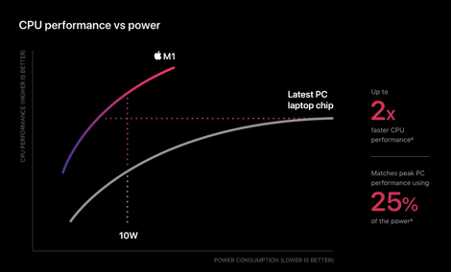
As per Apple’s benchmarks, the M1 offers 2X performance vs. conventional PCs. It offers the same performance as normal PCs at 1/3 the power. Apple’s website does not detail out the configurations, the benchmarks and the analysis. We cannot discount the fact that they might have cherry picked the benchmarks.
Intel’s narrative in response to Apple’s narrative
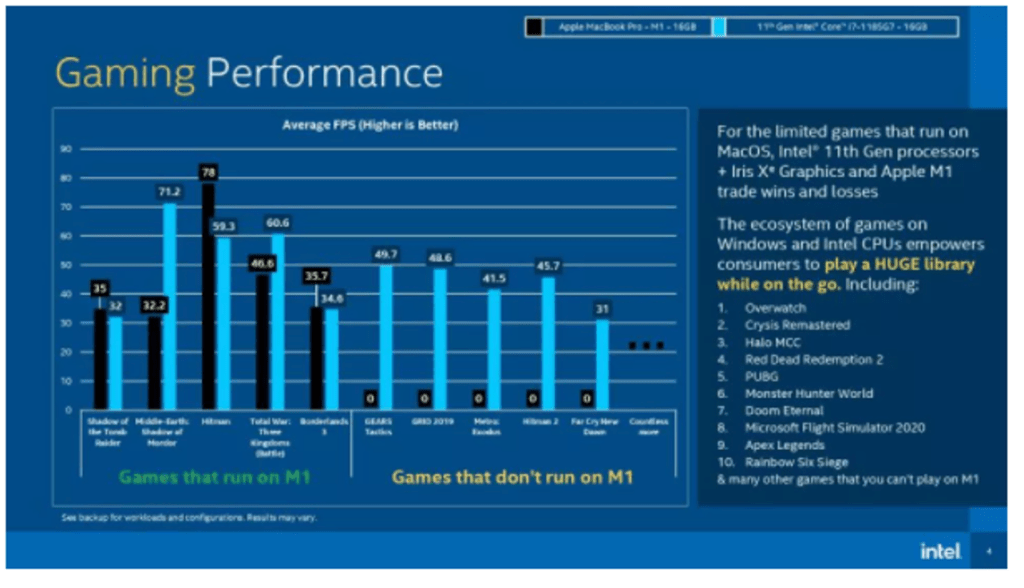
Intel has come with its own (may be cherry-picked) benchmarks to say why the Intel processor (11th Gen) is more powerful and has more application (read games) support.
Apple’s narrative to Intel’s counter narrative
There are some articles that state that Intel’s response is cherry picked and does not represent real life use cases. This discussion will go on and on and on.
It is clear however, that the M1 processor meets and exceeds the customer expectations in terms of performance. That they could device a fan less computer with performance comparable to that of a PC is astounding.
In Clarke’s terms, Apple has ventured a little way past the impossible barrier.
The Desolation of the Smaug
Intel’s problem is not M1’s benchmark performance. It is not M1’s thermal performance. It is not the fan-less design. Nor is it the graphic performance.
Intel’s advantage is not touch screens. Multiple screens. 360 degree laptops. They are mere design specifications, which can be done or undone in a few seasons.
Intel’s problem is the fact that M1 exists. That M1 exists as a viable alternative for computing. That M1 exists to Apple at a third of the cost of the Intel’s processor. (ok, my estimates)
A set of forces made M1 finally happen. We have seen it before: Mobile volumes, ARM licensing and TSMC manufacturing advances. They cannot be wished away. Nor reversed. Intel cannot stop the forward march of these forces, and they have already marched past Intel’s camp.
The same forces could come together again and again, year after year, generation after generation (remember Wintel’s effect on IBM?) and destroy the moats that protect Intel’s competitive advantage.
We started the Rosetta Stone series (The Treasure is in the fort) with the our favourite dragon (from the Lord of the Rings), Smaug guarding the treasure. With M1, there is a real possibility of the ‘Desolation of the Smaug’.
Intel is faced by the disaggregation of its competitive strength into three different companies (Apple, ARM, TSMC) and not having a play in largest volume franchisee in town. The competitive moat so carefully built, could be scurried away in the war ahead.
Will Intel allow it to happen? In a far different world than the ’90s, does it have the strategic depth? Can one company do what a village of companies are conjuring together? How will the new CEO Pat Gelsinger garner his forces and protect his moat? Will be build another source of competitive advantage for Intel?
Those are the multi-billion dollar questions.
Next: Written in Rosetta Stone #11 – An industry’s Laschamp Excursion
 Future starts mid-week