
The creation devouring the creator
Aurangzeb was the ambitious son of the pacifist Shah Jahan. In early years, it suited Shah Jahan, as Aurangzeb won their battles. But in 1666, the Shah who will die in 8 years couldn’t take Aurangzeb’s aggression, ambition and intolerance any further. Shah Jahan encouraged his eldest son Dara (a Sufi) to attack Aurangzeb. And that’s how, the son devoured the father – Aurangzeb killed Dara and kept Shah Jahan prisoner for the last eight years of his life, making himself the Emperor.
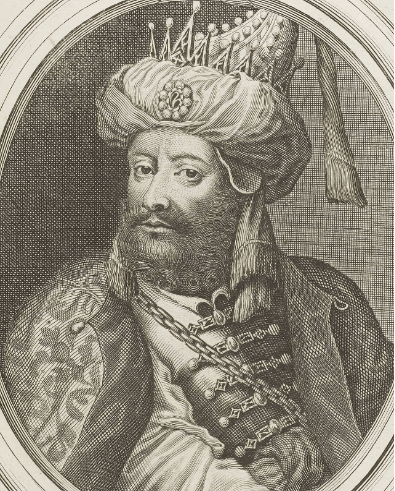
IBM faced a similar predicament as Shah Jahan. It created Intel’s new micro-processor avatar, and Intel was hijacking IBM’s agenda in just a few years.
The Computing Agenda Hijacked
From IBM’s vantage, the PC agenda was effectively hijacked by Intel, Microsoft and the IBM PC Clone goons. God damn it, Compaq’s sales people even sold PCs without their blue suits on. The business, that originated out of its secret R&D labs didn’t make sense to IBM any more. The business of assembling computers was far too operational and not profitable. But the PCs were eating into their profit pie. It was like Shah Jahan being threatened by his own creation, Aurangzeb.
Having created a monster, IBM promoted its own micro-processor, the PowerPC processor to complete with Intel. It was just like Shah Jahan promoting Dara to control Aurangzeb. Introduced in ’92, this RISC processor was a touted as a substitute for Intel x86. But it was Intel that won, the stronger player with wind behind its sails. In both cases, it was too little, too late.
Like Shah Jahan and Dara, IBM had to sacrifice the IBM PC business to keep itself alive.
IBM licked its wounds, but stayed smug thinking that the PC was never its game. It was always servers. The powerful, profitable AIX RISC boxes. Servers was where IBM was the Smaug. It was protecting its precious margins.

The marauder’s detour
It was late 13th century. After plundering the Middle East to its hilt, Mongols under Kublai Khan, raided Eastern Europe. The fragmented principalities couldn’t get together in time to protect their forts. Mongols used classic guerrilla warfare and divide and rule strategies. The loot out of Eastern Europe was as big as the earlier Middle East raids.
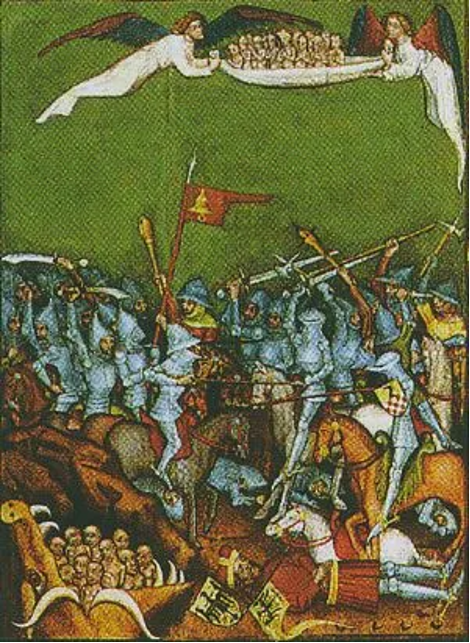
Intel raiding the fragmented server ‘principalities’
Around the turn of the century, IBM was protecting their server margins like Smaug. So was HP with PA RISC. So was Sun with Solaris and Spark. Silicon Graphics with the wonderful and eminently scalable Numa architecture. All ran proprietary RISC processors, with their proprietary UNIX operating systems. Ran their own fiefdoms. Look at them as some small principalities in Eastern Europe. Like Marovia or Dalmatia, say.
Now, the problem was with the application vendors. They had to create separate ‘ports’ of the same application for each of these RISC variants. So, if you are Ansys, making engineering simulation software, you need to create, port and test the software for IBM, HP and Sun variants, at the minimum. That was a lot of cost, but the principalities didn’t care – it was the tax for the sever application software vendors to be in business. The business of computing was booming. It was before the times when software ate hardware for lunch.
Like the Mongol force’s guerrilla divide and rule attack on the fragmented Eastern Europe, Intel in ’98 extended its x86 architecture from the PC domain to raid into the equally fragmented server domain. Initially, they launched their server processors as an extension of their flagship brand – it was called the Pentium II Xeon. Well, along came Windows NT – the first server operating system from Microsoft.
Intel Pentium 3 Xeon Logo Animation
It was a wide source of mirth in the traditional fiefdoms – Sun, IBM, HP. Which self-respecting CIO will even choose Wintel servers for their data centre? It was blasphemy. Were they even reliable?
It required a mega-disruption to establish Intel as the de-facto server processor vendor, overpowering all these ‘fragmented principalities’: The dotcom burn out.
It was the heady days of Boo.com and Pets.com. These server vendors were selling boxes by the truckloads to these fantastic new ideas.
There seemed to be no end, until the day it ended.
Now, we are at 2002. The dotcom bubble burst. The enterprises and the software vendors wanted to consolidate into one platform.
Then for a few years, the market folded itself and went into an unbelieving stupor. Software vendors were busy working to port their applications on Intel Xeons based on x86 and Windows. Linux brought in support to Intel x86 too. IBM, HP, and even Sun launched their Xeon server line-up, which co-existed with their own RISC line up.
Intel worked the Xeons through the debris of the dotcom era and emerged the winner of the Enterprise server space.
By the time the embers of the crash cooled down in 2005, Intel became the de-facto server computing standard for all but, most complex of requirements.
That gave Intel 15 more years of competitive advantage in the computing space. Your client and your server, both had Intel Inside.
How did Intel maintain its semiconductor product dominance over the years? How did they maintain the march Tick Tock Tick Tock Tick Tock?
It was an open secret. But the secret’s pass key was not available to any other company in the world.
The Moore’s Law.
Next: Written in Rosetta Stone #5: A law predicated by volume
 Future starts mid-week
Nice historical context to the story 🙂