
An empire is formed by winning other fiefdoms
Apple came up with the ‘Personal Computer’ Macintosh in 1984. It ran on Motorola processor (RISC) and the Mac operating system. In the early days, till Windows 3.0 and Pentium (’93), they had their time under the sun.
The open nature of the IBM PC eco-system ensured that multiple PC suppliers can get into the game and compete with each other, just assembling the parts efficiently. Compaq, Packard Bell, Digital and HP all figured out niche markets where IBM was not operating. They all depended on the CISC x86 standard, because, again, it is an IBM standard stupid. And consequently, they all depended on DOS and Windows. Intel and Microsoft, flush with margins protected by their hegemonic moat, supported the ‘go to market’ of their lower margin customers.
Every empire is formed in a bloody struggle. In the process of forming the empire, the weaker neighbours are vanquished. It is a bloody messy origin, where other competitors are subjugated along the way. Else, there is no way a empire is formed, a corporation is built or a standard established.
The Wintel hegemony’s power to vanquish other standards is represented by this photograph on the Time magazine (’97). Apple’s Macs didn’t sell as Apple thought they would. They were fast running out of cash.
Microsoft had to bail out their utter competitor Apple, with some extraordinary $150M funding and investment. That was the also the time Microsoft was embroiled in their anti-trust litigation with the US Government. That is also about of profits Apple will make PER DAY in 2021. (OK, its MY estimates).
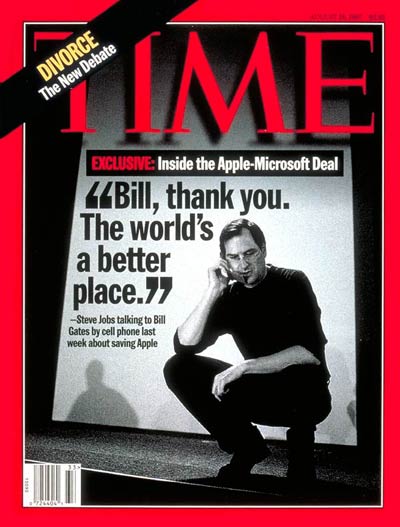
Source: MacWorld.
You cannot own the treasure chest in the fort, without winning a few bloody battles. The Intel- Microsoft hegemony won over every other standard in the early 90’s due to their backing by IBM and the sheer network effects. But they didn’t kill one of their competitors – Apple. They followed an honour code: You don’t kill your prime enemy’s Captain. You just take him for ransom. The enemy was Apple and the Captain was one Steve Jobs. Microsoft invested $150M in Apple and provided them the liquidity that allowed them to live another day.
Like we see in the movies, Microsoft probably kept the wrong guy alive. Little did Gates know at that time that Apple, the winnow Microsoft kept alive, will rise like Phoenix and stride like a Titan. The winnow will upend the entire eco-system and threaten the entire WinTel franchise in just a couple of decades.
Finally, Apple gave up its full stack ambitions and jumped ship from PowerPC to Intel in 2006. For Intel, that was the last bastion to be won over. Things couldn’t have been better for Intel at 2006.
Rosetta Stone
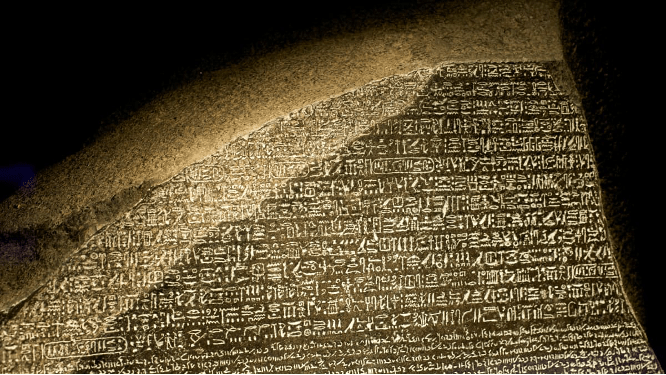
King Ptolemy V Epiphanes had an epiphanic moment 56BC. He ordered that his decrees were to be sculpted on stones in three different languages – so that it is understood by one and all. His decrees were written in Hieroglyphics, Demotic script and curiously in Ancient Greek. The stones were all but lost, buried in ruined architecture.
For centuries, experts tried to translate the Egyptian system of writing (Hieroglyphics) found in the pyramids and failed. There seemed to be no key. Then nearly 1900 years later, they unearthed the Rosetta Stone. The decrees of King Ptolemy V was faithfully written in three different languages, leading to cracking the ‘Hieroglyphics’ code. Suddenly the undecipherable jumble of Hieroglyphics sang the ancient songs of the Egyptian civilisation.
Here is Rosetta Stone: One decree in three languages:
Apple got its liquidity from Microsoft. It tottered along like a drunken monk until the iPod was launched in 2001. The Macs was still on PowerPC until 2006. In 2006, the Apple Mac shifted from PowerPC processor to Intel processors (The new power efficient Core processors). But, how will the applications work?
2006: When Mac announced shifting to Intel based processors: This was a crowning moment in Intel’s journey. Intel replaced IBM’s PowerPC in Apple. IBM’s PowerPC processor will not be viable any more. Now, there is just one computing standard. x86.
Apple wanted to leverage its application base written in Power PC on the Intel powered Macs. They introduced a “dynamic translator” called “Rosetta Stone”. This helped them to transition the applications quickly from Power PC to x86, thus leveraging the performance of the newly introduced Intel Core processors.
Little did anyone realise in 2006 that for the determined master, a code is a code.
You break it once. You can break it again.
Apple came up with Rosetta II 14 years later in 2020 and set it to do the exactly the reverse of what Rosetta I achieved. It used the Intel-iOS applications on systems powered by Apple’s own processors – the M1.
With the second processor shift in 2020, Apple set up a course that will change the world of computing forever. Loyal aides and decades of continuous improvement made such a momentous change possible.
Rosetta Stone II is the reason this blog series was written. Read on.
Written on Rosetta Stone #4: The creation devouring the creator
 Future starts mid-week