
Part 1: There is treasure inside the fort
In the Lord of the Rings, Smaug the dragon protects the treasure inside the fort. This blog series (you will ultimately be force fed 14 more blogs, God bless you :)) “Written on Rosetta Stone” is not about the treasure. This is not about the dragon either.
It is about the fort and the power it represents.

Source: Creative Commons
A moat is a competitive advantage that a business or a company has built for itself. This moat prevents its competitors from attacking its offerings and taking away its business. Thus companies with competitive advantages (or moats) can protect their revenue and the margins for a prolonged period of time.
One of the most enduring moats is what Intel built around its processor business. A moat’s job is to protect the treasure and keep building on it. Before we examine the moat, can we examine what is Intel’s treasure?
Intel’s treasure is represented by its market share and the margins from its CPU business. Let us use the year 2018 as the benchmark.
Operating income and Revenue from the PC Processors:
In 2018, it was $14.2B Operating income from a revenue of $37B. 38% was the operating income on the PC.

Operating income and Revenue from the Server Processors:
In 2018, it was a whopping $11.5B operating income on a revenue of $23B. 50% flat, operating income. Wow and that grew by a whopping 36.7% yoy. Operating income of course is the profits before interest and taxes.
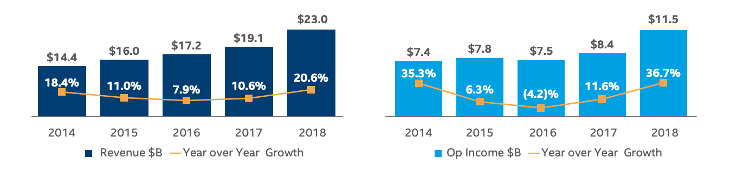
Source: Intel’s Annual Statement for 2018.
This represents an Operating Margin of over 35% and a Gross Margin of 61% in 2018, compared to the Apple’s gross margin of ~38% in 2020.
Intel is a money making machine. And wonder of wonders, it has been building and protecting its moat since 1978!
So, these are the questions this blog series answers:
In the mercurial, whimsical world of technology, where a charger standard changes every two years, how can a 1978 processor standard (x86) hold sway even in 2016?
What is the secret of the moat? What protects Intel’s enduring treasure?
Then, did a tiny hobbit appear one fine day to steal away the treasure from the Smaug?
Could you pinpoint that momentous change to the whim of a specific moment?
Is there a ‘singularity point’ that will stand as an enduring symbol of the change?
Who are the new leaders? What will happen to the other players in the eco-system?
When will the regime change again?
What has the Rosetta Stone have to do with all this?
To know more, you have to endure 14 such blogs.
PS: I used to work for Intel for most of the first decade of 2000s. Its a great place to work and learn.
Next: Written on Rosetta Stone #2: First the fort, then the treasure
 Future starts mid-week