
Moore’s law is predicated by volume
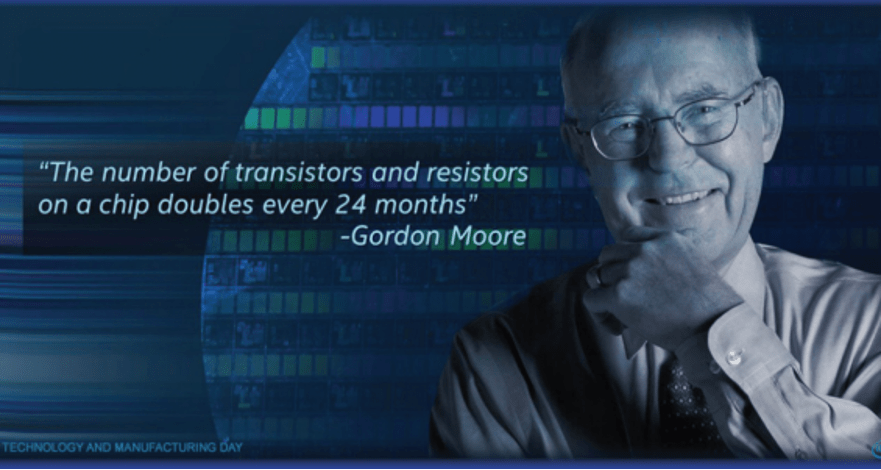
Remember, Intel’s position as a pre-eminent Silicon supplier was consolidated by the Moore’s law. Moore’s law is the inexorable march of doubling the number of transistors in a given package every 18-24 months, simplistically speaking. It was more a business goal that you have to work towards making true, than an irrevocable law of nature. Intel had thousands of engineers and billions of dollars of R&D funding to make Moore’s Law a reality. It was and remains, the Moore’s Law company.
Intel humongous performance increases, generation after generation was made possible by Moore’s Law. How did Intel achieve it? They did it by putting in more and more ‘ready made wiring’ in the processor. More and more transistors. Commands from the software became easier to execute. Performance galloped. Intel also added more ‘cores’ or brains in the same processor dye.
All this added millions and millions of transistors to the processor.
What will that result in? In a normal world, as the number of transistors in the processor go up, the size of the processor will go up proportionately.
If the latest Xeon is packed in the same way the initial 8088 was packed, the whole processor will be 3m * 3M. Size of two snooker tables kept side by side.


Yet, how is it under 2.6 cm * 2.6 cm? That is because this is in a magical world that shrinks every day. That is due to extraordinary developments in process technology. The mighty boffins at Intel (and other fab companies) figure out a way to pack the transistors closer and closer to each other, without the signals interfering with each other.
This is fundamental to progression of processing power. Packing transistors closer and closer to each other. To pack enormous complexity in a small chip. To infuse more performance that will help perpetuate Moore’s law. To reduce power consumption to make those sleek little laptops.
But the business of keeping Moore’s law true also costs a lot of money. Not in Millions with M. It is Billions with B.
Intel with its primacy, revenue, growth, margins, cashflow and vision was the master of the game.
Intel with its world leading microprocessor volumes, was able to spend the billions of dollars in every process step, shirking the processor every couple of years or so. In early 2000s, they had the volumes from the PC Processors – so they could shrink it like no other vendor could. No other vendor in the server space, neither IBM, nor HP (with PA RISC) or Texas Instruments or Motorola or Toshiba had the volumes and the profitability to fund this exhausting tiger march. It was only Intel.
IBM, HP, Sun were the server vendors of the 90s, were making their own server processors. With Xeons, they started lagging behind. They found it easier to just build it on Intel. The network ceased to be the computer – the CPU was the computer.
By the middle of the first decade, independent software vendors gotten used to porting their software only on x86. Gone were difficult ports for PA RISC, IBM RISC, Sun, SGI and myriad different standards.
AWS came along in 2006, they had banks and banks of Intel servers, making the decision easier for the Independent Software Vendors. Amazon of course built AWS on Intel based on its earlier experience. Didn’t they spend the entire year 2000 shifting their nascent shopping platform from Sun to Intel-Linux?
So, Moore’s law was driven by volumes. In the course of the first decade , Intel usurped the server crown. Even enterprise critical applications like SAP implementations were happening on Xeon boxes. Things couldn’t have been better for Intel at 2006.
The x86 juggernaut devouring its sibling:
Even Intel felt uncomfortable with its x86 primacy. They brought in Itanium, a new architecture processor aimed at the enterprise market, but there was too much wind behind the x86 sails.
The million competitive benefits of Moore’s law was stacked in favour of the margin and volume driver in the semi-conductor business.
The Xeon performance volcano singed the server market trail and made every other server standard (nearly) irrelevant.
Xeon’s sibling Itanium itself had its exhausting last sigh in 2017, when Intel gave it a quiet burial.
Hold on. Is this a favourable wind or a distant thunder storm?
Itanium 2: The future that wasn’t
Written on Rosetta Stone #6: Favourable wind or a distant thunder storm?
 Future starts mid-week